Teilen Sie Ihre Erfahrunge und Wünsche mit uns und anderen Usern!

 Error importing the Package
I get this error when I import the package to Unity:
Assets/game4automation/private/RuntimeUI/SceneMouseNavigation.cs(801,38): error CS0103: The name 'SpaceNavigator' does not exist in the current context

No Mutex PLCSim Advanced Interface proble
Hello,
we are using the PLCSim Advanced Interface.
We can Import the PLCSignals without any Troubles:
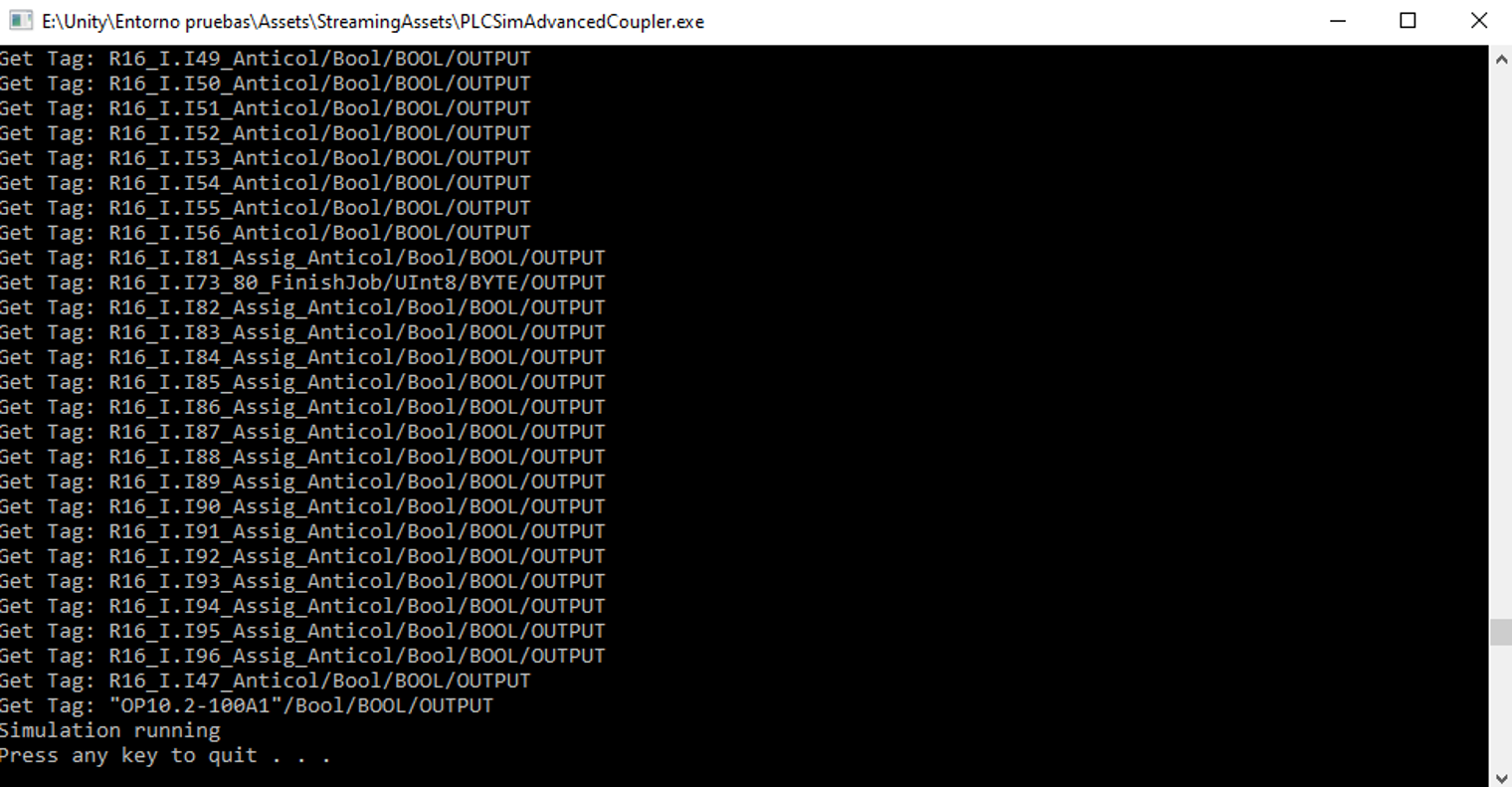
The first time that we start the simulation in Unity everything is working fine (COM OK).
But after we stop the unity editor and try to start again, we get “No Mutex”... so no communication is established between the plc and Unity.
We found out that creating a new PLC Instance and re-importing the signals “fix the error”... but just for the first run. Then we have to repeat the process of creating a new PLC again and again...
Could be some background process blocking the communication? Thank you in advance.
PLCSimAdvancedCoupler MissingMethodException – IRemoteRuntimeManager.CreateInterface not found (all API versions tested)
I'm getting a MissingMethodException from the PLCSimAdvancedCoupler when clicking "Import Signals" in Unity. No signals are loaded.
Environment:
- realvirtual.io / game4automation package (older branding, folder in project is still named
game4automation) - PLCSimAdvancedCoupler version: 6.0.7 (Changeset: 8030)
- Unity version: 6000.3.2f1 (Unity 6 LTS)
- S7-PLCSIM Advanced V8 installed
- All API folders from 3.0 up to 8.0 are present under
C:\Program Files (x86)\Common Files\Siemens\PLCSIMADV\API\ - PLC instance name: PLC_1
Console output from PLCSimAdvancedCoupler.exe:
=================================================================
PLCSimAdvanced Coupler - 6.0.7 (Changeset: 8030)
Instance: PLC_1 | Cycle: 10 ms
=================================================================

Unhandled exception: System.MissingMethodException: Method not found: 'Siemens.Simatic.Simulation.Runtime.IInstance Siemens.Simatic.Simulation.Runtime.IRemoteRuntimeManager.CreateInterface(System.String)'.
   at PLCSimAdvancedCoupler.PLCSimInterface.OpenInterface(String name, String remote)
   at PLCSimAdvancedCoupler.PLCSimInterface.Connect(String name, Int32 time, String remote, Int32 syncms)
   at PLCSimAdvancedCoupler.Program.Main(String[] args)
What I've already checked/tried (all without success):
- The PLC_1 instance exists and is running in S7-PLCSIM Advanced (verified directly in the Siemens tool, independent of Unity)
- Manually changed the "Siemens DLL" field in the PLCSIMAdvancedInterface Inspector to point to each installed API version one by one (2.0, 3.0, 4.0, 5.0, 6.0, 7.0, 8.0) — same error every time
- Unity Editor run as Administrator
- Antivirus/firewall interference ruled out
- There is no "Remote" field visible in the PLCSIMAdvancedInterface Inspector to check/clear a remote address
- DebugMode was available to enable but I haven't seen additional detail beyond the exception above yet
Question:
Since the error occurs specifically in the IRemoteRuntimeManager.CreateInterface(String) call path (not the local/non-remote path), and happens regardless of which installed API version is referenced, is this a known compatibility issue between Coupler 6.0.7 and current PLCSIM Advanced versions (V6–V8)? Is there an updated/patched PLCSimAdvancedCoupler.exe available, similar to what was provided in this related thread: [Link zum Forumsthread "S7PLCSIM Advance connection problem" hier einfügen]?
I could not find the coupler.log in the following directory Assets\game4automation\private\Interfaces\PLCSimAdvanced\Ressources that'S why i Cannot share it

No automatic ADS reconnection after TwinCAT PLC reboot
Hi,
we use realvirtual's TwinCatAdsInterface to communicate with a TwinCAT PLC.
When the PLC reboots, the ADS connection is lost. We receive the anticipated connection-loss error message and all stages move into their configured default positions. However, once the PLC is available again, our application does not reconnect automatically. Normal operation is restored only after restarting our application.
Another application (C# .NET app which is also using the ADS library) connected to the same PLC is able to reconnect successfully after the PLC reboot.
If we use a simulated PLC, the real-virtual interface can reestablish the connection, the problem only occurs when we work with a real PLC.
Environment:
- Unity: 6000.3.22f1
- realvirtual Professional: 6.3.5
- realvirtual Starter: 6.3.5
- TwinCAT/PLC version: v3.1.4026.14
- ADS port: 851
- Update cycle: 100 ms
Steps to reproduce:
1.Establish communication with a real PLC.
2. Confirm normal operation.
3. Reboot the PLC or restart the TwinCAT runtime.
4. Wait until the PLC is available again.
5. Observe the ADS connection without restarting our application.
Expected result:
The TwinCatAdsInterface reconnects automatically after the PLC becomes available again.
Actual result:
The connection-loss error is reported and the stages move to their default positions, but the ADS connection is not restored. Restarting our application is required.
Could you please advise whether a specific reconnect configuration or API call is required, and whether this behavior is a known issue in realvirtual 6.3.5?
 Configure Position and Size of Orthographic Overlay Views
Hi,
we are using Unity 6.3 with realvirtual Professional.
When the three orthographic views are enabled, they appear in the lower-left corner and overlap our application UI. We would like to configure their layout so that they can be displayed in the lower-right corner instead.
It would be helpful to configure each view individually:
- Position using X and Y
- Size using Width and Height
- Separate settings for the Front, Top, and Side views
Ideally, these settings could be configured through the Unity Inspector or a ScriptableObject and remain active during runtime.
Is there currently a supported way to configure the position and size of the orthographic overlay views? If not, could this be added as a feature?
Thank you.

Bug
I use Unity6000.0.58f version and I imported Realvirtual Digital Twin Starter 6.3
And I got these errors
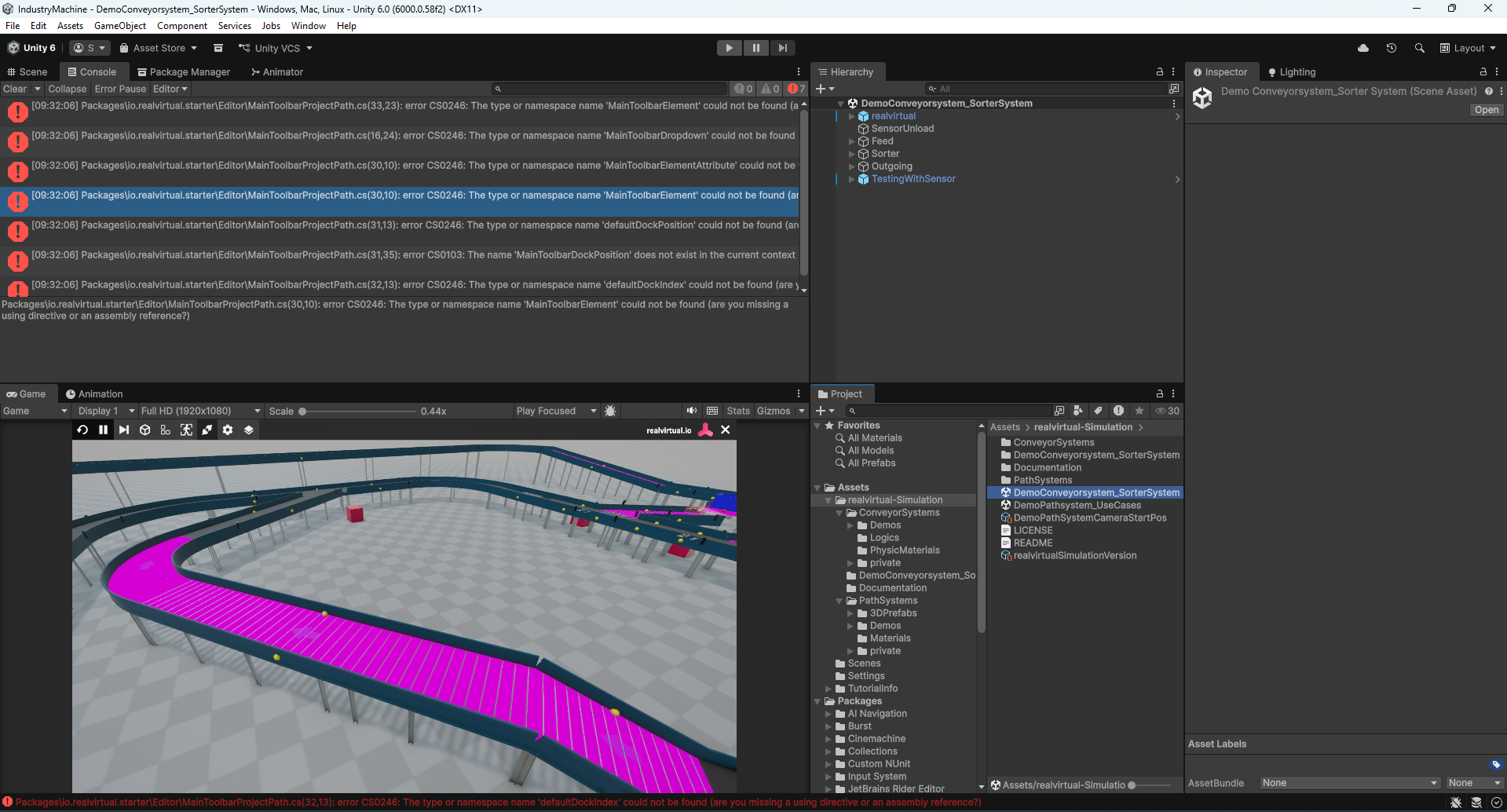

Hi sandong0313,
thanks for the report. These compile errors come from a Unity / realvirtual version mismatch: the realvirtual Digital Twin Starter 6.3 is built for a newer Unity 6000 LTS than 6000.0.58f, so the scripts do not compile on your Editor.
Two options:
1) Switch your project to the Unity 6000 LTS version that Starter 6.3 targets and re-import the package.
2) Or stay on Unity 6000.0 and use the matching realvirtual 6.0.x Starter release instead of 6.3.
Installation guide: https://doc.realvirtual.io/
To point you to the exact compatible build, could you confirm your Unity version (Editor > About)?
Best regards

 TRIAL
TRIAL
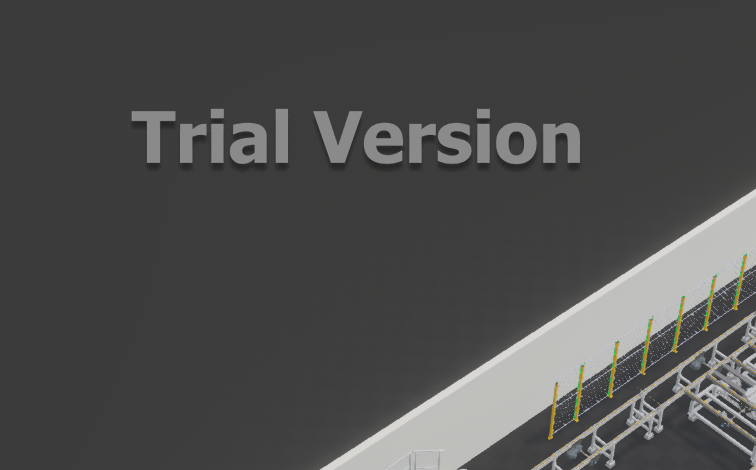
Hi, after making a build for the windows platform I see a big inscription trail verison, I have purchased the pro version, what's going on, the matter is urgent!

Downloaded version mismatch
Hello,
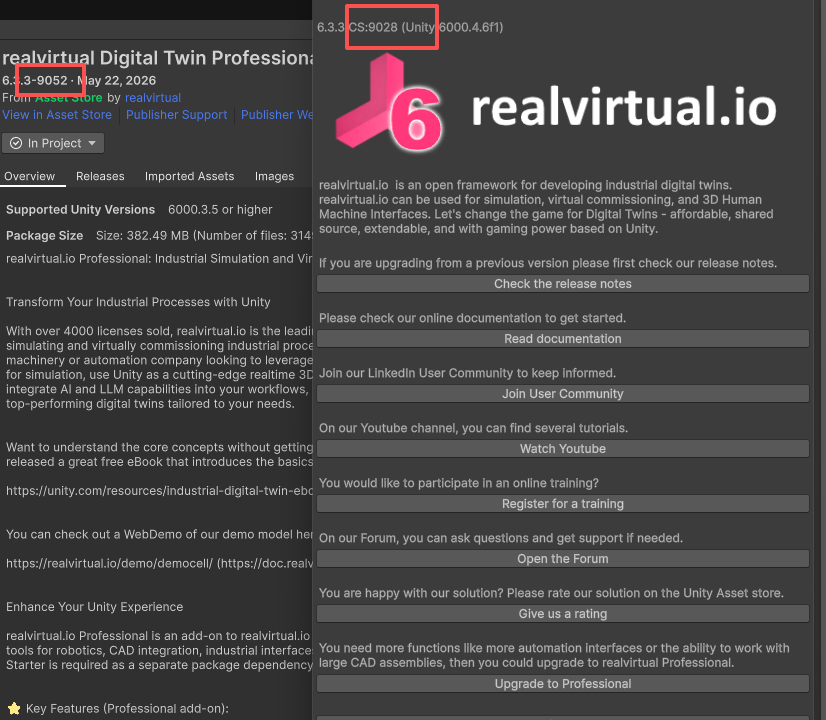
I selected version 6.3.3-9052 for download, but upon importing the downloaded file locally, the actual version turned out to be 6.3.3-9028.
Similarly, when attempting to download version 6.0.12-8862, the file I received was 6.0.12-8592.
I have verified this behavior through multiple tests, and the results were consistent each time; other users have also reported this issue.
I look forward to receiving a reasonable explanation from the official team.

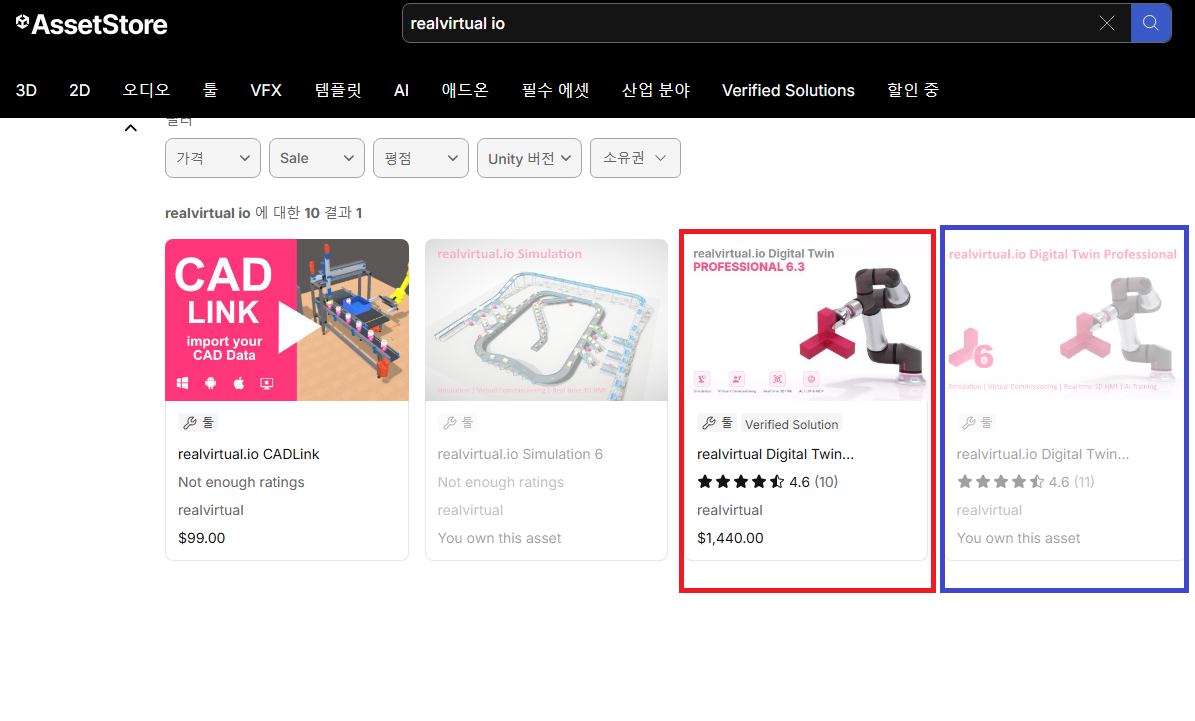
RealVirtual I.O Digital Twin Professional version 6 vs 6.3
Dear,
I purchased and am currently using RealVirtual I.O Digital Twin Professional version 6.
Recently, when I tried to update my Unity project to version 6.3,
I discovered that RealVirtual I.O Digital Twin Professional version 6.3 must be purchased separately.
I have two questions.
1) Do users who purchased RealVirtual I.O Digital Twin Professional 6.0 have to pay to purchase version 6.3 again?
(Is there no policy for upgrade costs rather than new purchases?)
2) Could you please tell me the key feature differences between RealVirtual I.O Digital Twin Professional 6.0 and 6.3?
Thanks.
Best regards,
Seokhyun Lee
PLCSimAdvancedCoupler.exe
Hi, when I try to run PLCsimAdvance and configure it, the same error appears as on SS and, the PLCSimAdvancedCoupler.exe download page does not exist.

Customer support service by UserEcho